
Performance Testing in tennis and the link to ACL Rehab
Introduction
Tennis is characterized by repeated accelerations, decelerations, and rapid changes of direction under time pressure and high cognitive load. These movement demands place substantial stress on the knee joint, making injuries such as anterior cruciate ligament (ACL) ruptures an injury that can occur. However, tennis-specific ACL epidemiology remains poorly described, with existing data being incomplete and inconsistent (Holst-Christensen et al., 2025) .
Recent evidence shows that ACL injuries in tennis frequently occur during lunging, forward running, and explosive directional changes, all of which are fundamental components of match play (Holst-Christensen et al., 2025) . A typical injury scenario involves a player, anticipating movement in one direction, but being forced to rapidly react to a ball played in the opposite direction. This results in a sudden rotation of the body and knee under load while the foot is external rotated.
Return to tennis (Return to sport = RTS) rate is 72%, however only a smaller proportion of players 25% returns to their pre-injury performance level, highlighting the importance of both performance testing and rehabilitation strategies in tennis (Holst-Christensen et al., 2025) .
Given these demands, physical performance testing plays a critical role not only in optimizing performance but also in reducing injury risk and guiding return-to-play decisions.
Physical Performance Testing in Tennis
A recent systematic review including over 8000 youth players identified a wide range of physical tests used in tennis, covering speed, agility, strength, and power (Axman et al., 2025).
Commonly used tests in the literature:
- Speed
- 5 m, 10 m, and 20 m sprint tests
- Agility / Change of Direction
- Power / Jumping
- Upper-body performance
- Medicine ball throws (forehand/backhand/overhead)
- Serve velocity testing
- Strength
- Handgrip strength (Link)
- Flexibility / Mobility
- Shoulder flexibility tests
These tests provide insight into an athlete’s physical profile, helping identify strengths, weaknesses, and potential injury risks .
Why Focus on the Countermovement Jump (CMJ)?
Among all physical tests, the countermovement jump (CMJ) stands out as one of the most informative and widely used tools in tennis (Axman et al., 2025).
1. Measures key neuromuscular qualities
The CMJ is a multi-component test, capturing:
- Neuromuscular performance
- Concentric and eccentric force production
- Rate of force development
- Lower-limb power
- Reactive strength index (RSI)
These qualities reflect the neuromuscular demands of explosive movements and are commonly assessed through vertical jump testing in tennis players (Moya-Ramón et al., 2020).
2. Strong link to tennis performance
Research shows that CMJ height is strongly associated with:
- Sprint performance
- Explosive movements
- Serve velocity (r ≈ 0.77) (Hayes et al., 2021)
This reflects the importance of lower-body power in the kinetic chain, especially during serving and groundstrokes (Hayes et al., 2021) .
3. Reflects sport-specific demands
Tennis involves:
- Short explosive efforts (2–10 seconds)
- Frequent direction changes
- Rapid force production
These characteristics closely mirror the neuromuscular demands assessed in a CMJ
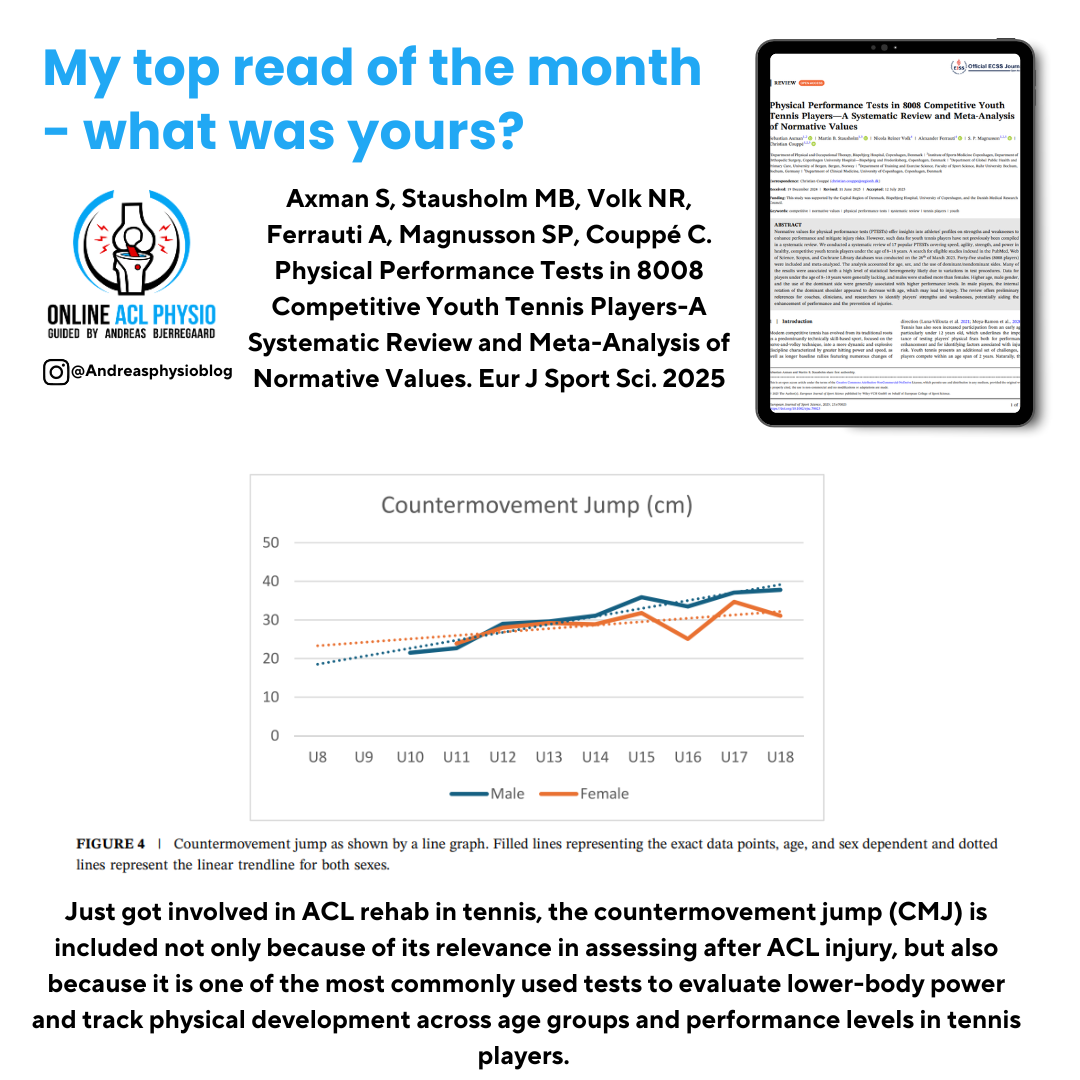
Axman et al., 2025 should very nicely CMJ and sprint capacity according to age in tennis.
CMJ and ACL Rehabilitation in Tennis
👉 Just got involved in ACL rehab in tennis, the countermovement jump (CMJ) is included not only because of its relevance in assessing after ACL injury, but also because it is one of the most commonly used tests to evaluate lower-body power and track physical development across age groups and performance levels in tennis players.
Key Takeaways
- Tennis is an explosive, high-load sport
- Physical testing is essential for both performance and injury management
- The CMJ has relevance to tennis demands
References (APA)
Axman, S., Stausholm, M. B., Volk, N. R., Ferrauti, A., Magnusson, S. P., & Couppé, C. (2025). Physical performance tests in 8008 competitive youth tennis players—A systematic review and meta-analysis of normative values. European Journal of Sport Science.
Hayes, M. J., Spits, D. R., Watts, D. G., & Kelly, V. G. (2021). Relationship between tennis serve velocity and select performance measures. Journal of Strength and Conditioning Research, 35(1), 190–197.
Holst-Christensen, T., Hölmich, P., Andersen, F. F., & Kaldau, N. C. (2025). Anterior cruciate ligament injuries in tennis: Injury mechanism and return to sport rates following injury. Scandinavian Journal of Medicine & Science in Sports.
Moya-Ramón, M., Nakamura, F. Y., Teixeira, A. S., Granacher, U., Santos-Rosa, F. J., & Sanz-Rivas, D. (2020). Effects of resisted vs. conventional sprint training on physical fitness in young elite tennis players. Journal of Human Kinetics, 73, 181–192.
Torre, G., Vasta, S., Rocchi, J., Papalia, R., & Mariani, P. P. (2024). Autograft choice and jumping performance after anterior cruciate ligament reconstruction. Orthopaedic Journal of Sports Medicine, 12(10).

