Patella dislocation & medial patellofemoral ligament reconstruction.
What is patella dislocation?
The reason for lateral patella dislocation (LPD) can be affected by both primary and secondary factors. The primary instability factors have been identified as trochlear dysplasia, excessive tibial tubercle-trochlear groove (TT-TG) distance and patella alta (1). The secondary factors include femoral anteversion, excessive lateral tibial torsion, recurvatum and genu valgum. These factors may impact on which type of surgery is indicated.
The vast majority of patella dislocations occur in a lateral direction.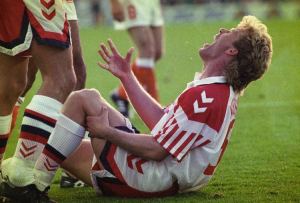
What is medial patellofemoral ligament (MPFL) surgery?
In case of patella dislocation, surgery can be indicated after recurrent patella dislocations if no satisfactory results have been achieved through conservative treatment (2,3,). It is often debatable how many dislocation that need to happen before surgery is offered. The purpose of this type of surgery is to provide a stabilizing effect of the patella, providing medial restraining forces to prevent redislocation. However, with the literature, many different surgical techniques has being used.
Some of the more commonly used surgical techniques is categorize in three groups: 1) MPFL reconstruction with autologous graft (Gracilis), 2) MPFL medial structures repair (with Plication), 3) MPFL reconstruction combined with tibial tubercle transfer osteotomy (TTTO) (Hauser or Fulkerson). The most commonly a semitendinosus or gracilis autograft is used through a tunnels or interference screws.

History and injury mechanism
The patient often describes a sudden pain with a rotation activity, combined with a feeling of a pop or something going out of place. It is important to ask for how long this patella was displaced it was “pop” or pushed in again.
There may be a history of generalized ligamentous laxity/other dislocations. The injury can also follow from an acute trauma. When the patella is dislocated or tendon ruptured it will be a visible trauma.
Patella dislocation (specially first-time) can sometimes be treated conservative, opposite a rupture of the patella tendon must be surgical repair followed a intensive rehabilitation.
Many Danish spectators still remember Henrik Andersen Patella dislocation trauma in the UEFA Euro 1992 Semi–finals between Denmark and Holland. A tournament which has been call and properly ever will be the biggest Danish sports sensation.
Rehab considerations
After MPFL reconstruction rehabilitation can take up to 1 year to normalization knee kinematics and return to normal gait.
There is no consensus on return to sport timeline or criteria, however it has been suggested that adolescent athletes undergoing MPFL reconstruction might need prolonged rehabilitation beyond 8 months (7, 8).
Weightbearing after MPFL reconstruction varies and is based on surgeon preference. Range of motion should be unaffected by axial load and limitation in weight bearing as long as rotation of the joint is restricted. Usual full weightbearing as tolerated with brace for two weeks. In case of tibial tubercle transfer osteotomy weightbearing and brace need to be consider accordingly to surgical guidelines.
Ask for D-vitamin defiency in relation to bone and soft tissue healing.
Rehab program
Early phase 1-8 weeks
Always follow the protocol provided by the surgeon. Usual there will be a short period of partial weightbearing and limited range of motion and use of knee brace.
The goal is to protect the repair, control swelling and pain, restore knee range of motion, neuromuscular control and quadriceps activation and prepare for normal gait when crutches is removed.
General guidelines
- Cardiovascular: Upper body cardio early on into range limited lower limb.
- Cross-education: Leg strengthening of the uninvolved leg may improve post surgical recovery of quadriceps muscle in the reconstructed limb
- Core: Adding core strengthening have been found to be beneficial for knee pain and balance
- Monitor and decrease swelling – elevation of operated limb and ankle pumps
- Patient education about surgery and rehabilitation progression. Gait re-education depending on surgeon instructions regarding WB.
- Add hydrotherapy when wound is closed
Example of restriction for the first weeks could be:
MPFL with Gracilis tendon:
- Brace – Week 1 0-30 deg, Week 2 0-45 deg, Week 3-4 0-60 deg, Week 5-6 0-90 deg
- WB AT for 2 weeks then FWB.
- ROM 15 degrees more than brace
MPFL with medial repair
- Brace – Week 1-3 0 deg, Week 3-6, 0-30 deg
- WB AT for 2 weeks then FWB.
- ROM 15 degrees more than brace
MPFL and tibial osteotomy
- Brace – Week 1-3 0-30 deg, Week 4-6, 0-45 deg
- WB – NWB or TT for 3 weeks. PWB for week 4-6.
- ROM 15 degrees more than brace
Early range of motion and muscle activation exercises week 1-4
Modalities: NMES/EMG/BFR) together with exercises
- Quadriceps contraction
- SLR
- Short arc knee extension 0-20 deg (week 1/2)
- Isometric leg press SL at 45 deg (week 2)
- Mini squat short arc (week 2/3)
- Hip strengthening (week 1)
- Prone hip extension
- sidelying hip abduction,
- Clams
- Adduction ball squeeze holds
- Calf muscles strengthening
- Resisted Plantar/Dorsi flexion with Theraband
- Heel raises
- prone knee flexion
- heel digs (week 1)
- heel bridges BL (week 2)
- DL balance (week 1 as tolerated and surgical restrictions) progress to SL based on quads muscle control
Early Phase 2 – Protective phase/early strengthening (Approx. 4-8 weeks)
Goals
- Protecting the repair
- Achieve more than 90 degrees knee flexion at week 6 for MPFL reconstruction and 115-120 degrees at week 8 based on surgeons instructions.
- Able to stand on 1 leg with good control and alignment
- Achieve no or minimum knee lag
- Gait re-education
Examples of exercises for 4-8 weeks
Modalities: continue with NMES and BFR
- Prone knee flexion progress to knee flexion in standing (week 4/5)
- Progressive quadriceps and hamstring strengthening
- Mini squat
- Leg press dynamic progressive 0-90 DL to SL (from week 5), start with 0-45 degrees to avoid high stress on the patellofemoral joint.
- step up
- Knee extension progressive based on ROM with BFR
- Hip strengthening
- Hip flexion
- Hip abductor/adductor
- 1 leg balance with good control and alignment progress to unstable surfaces and ball throw
- Wobble board
- Cone touch SL balance
Intermediate Phase – Early strengthening phase (Approx. 8 -12 weeks)
1. Chouteau, J., Surgical reconstruction of the medial patellofemoral ligament. Orthop Traumatol Surg Res, 2016. 102(1 Suppl): p. S189-94.
2. Fisher, B., et al., Medial patellofemoral ligament reconstruction for recurrent patellar dislocation: a systematic review including rehabilitation and return-to-sports efficacy. Arthroscopy, 2010.
3. Manske, R.C. and D. Prohaska, REHABILITATION FOLLOWING MEDIAL PATELLOFEMORAL LIGAMENT RECONSTRUCTION FOR PATELLAR INSTABILITY. Int J Sports Phys Ther, 2017.
4. Straume-Naesheim, T.M., et al., Recurrent lateral patella dislocation affects knee function as much as ACL deficiency – however patients wait five times longer for treatment. BMC Musculoskelet Disord, 2019.
5. Sillanpaa, P.J. and H.M. Maenpaa, First-time patellar dislocation: surgery or conservative treatment? Sports Med Arthrosc Rev, 2012.
6. Asaeda, M., et al., Knee biomechanics during walking in recurrent lateral patellar dislocation are normalized by 1 year after medial patellofemoral ligament reconstruction. Knee Surg Sports Traumatol Arthrosc, 2016.
7. Biesert, M., et al., Self-reported and performance-based outcomes following medial patellofemoral ligament reconstruction indicate successful improvements in knee stability after surgery despite remaining limitations in knee function. Knee Surg Sports Traumatol Arthrosc, 2020.
8. Saper, M.G., et al., Return-to-Sport Testing After Medial Patellofemoral Ligament Reconstruction in Adolescent Athletes. Orthop J Sports Med, 2019.