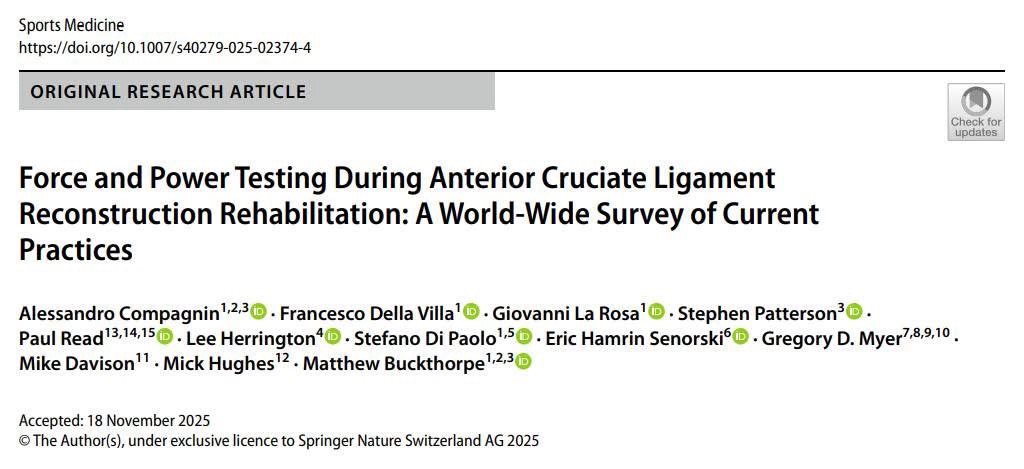
This is the article I have been looking forward to the most in 2025—and it arrived on the very last day of the year. Congratulations to Alessandro Compagnin and colleagues, who collected questionnaire responses from 1,154 clinicians across 78 different countries regarding their testing of force and power in ACL rehabilitation.
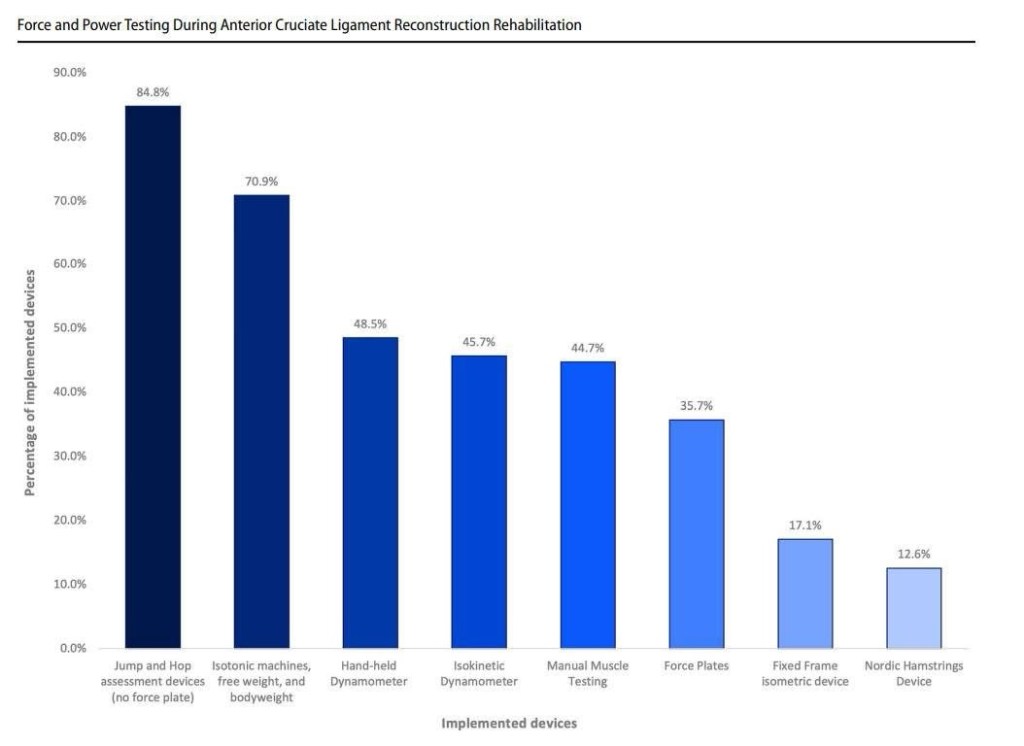
🔗 In the survey, 48.5% reported that they had implemented the use of handheld dynamometry.
1️⃣ Comment: This should be a minimum requirement to be allowed to rehabilitate ACL patients in Denmark.
🔗 In the survey, 45.7% reported that they had implemented isokinetic testing.
2️⃣ Comment: There is not a single municipal or private clinic in Denmark with an isokinetic device. There are a few places—such as Team Denmark, Bispebjerg Hospital, SDU, and Esbjerg Hospital—that have one, but these are not facilities patients can be referred to. Therefore, the conclusion must be that implementation in Denmark is effectively 0%, since there are no referral options to access the gold standard in muscle testing.
🔗 In the survey, 44.7% reported using manual muscle testing for strength assessment. 44.7%! Of these, 93.8% used it to assess knee extensor strength.
3️⃣ Comment: This is better than no testing at all, which I unfortunately still hear about far too often. There are far too many ACL patients who attend their 1-year surgical follow-up where knee laxity becomes one of the only objective return-to-sport criteria. Access is also unequal due to geographical or financial reasons. I therefore hope that, in the future, patients will be offered muscle testing at the hospital where they were operated on. In my view, this should fall under quality control.
🔗 In the survey, 35.7% reported using force plates.
4️⃣ Comment: Very few clinics in Denmark currently have force plates, but this is gradually changing. They are now widespread in most sports clubs, and several municipal rehabilitation centers have also begun investing in them. Perhaps Jonas Osmundsen and Claes Jakobsen can comment on how widespread force plates are in Danish clinics. Unfortunately, I do not think we are anywhere near 35.7%. As with handheld dynamometry, I hope this will become a minimum requirement for ACL rehabilitation, and that we simultaneously become better at implementing it within a broader rehabilitation context.
🔗 In the survey, 17.1% reported using fixed-frame isometric devices.
5️⃣ Comment: I believe there are two clinics in Copenhagen with force frames. I have found it very difficult to refer patients to clinics that measure soleus strength. We are therefore likely nowhere near 17%.
Overall, this study shows that we still have a long way to go in implementing criteria-based testing, and I unfortunately believe that the figures in Denmark are significantly lower. My hope is that power and force testing will become part of the 1-year follow-up, on equal footing with knee laxity and questionnaires.