I’m proud to have played a small part in the new ESSKA–AOSSM–AASPT Formal EU-US ACL Rehabilitation Consensus, which was presented at the ESSKA Congress in Prague 20-22 May, 2026
Find a summary or the complete concensus report here:
- The Formal EU-US ACL Rehabilitation Consensus – Summary
- The Formal EU-US ACL Rehabilitation Consensus – Complete Report

I had the privilege of contributing as a member of the European Rating Group, where my role was to independently evaluate and provide feedback on the clinical questions and consensus statements developed by the international Steering Group.
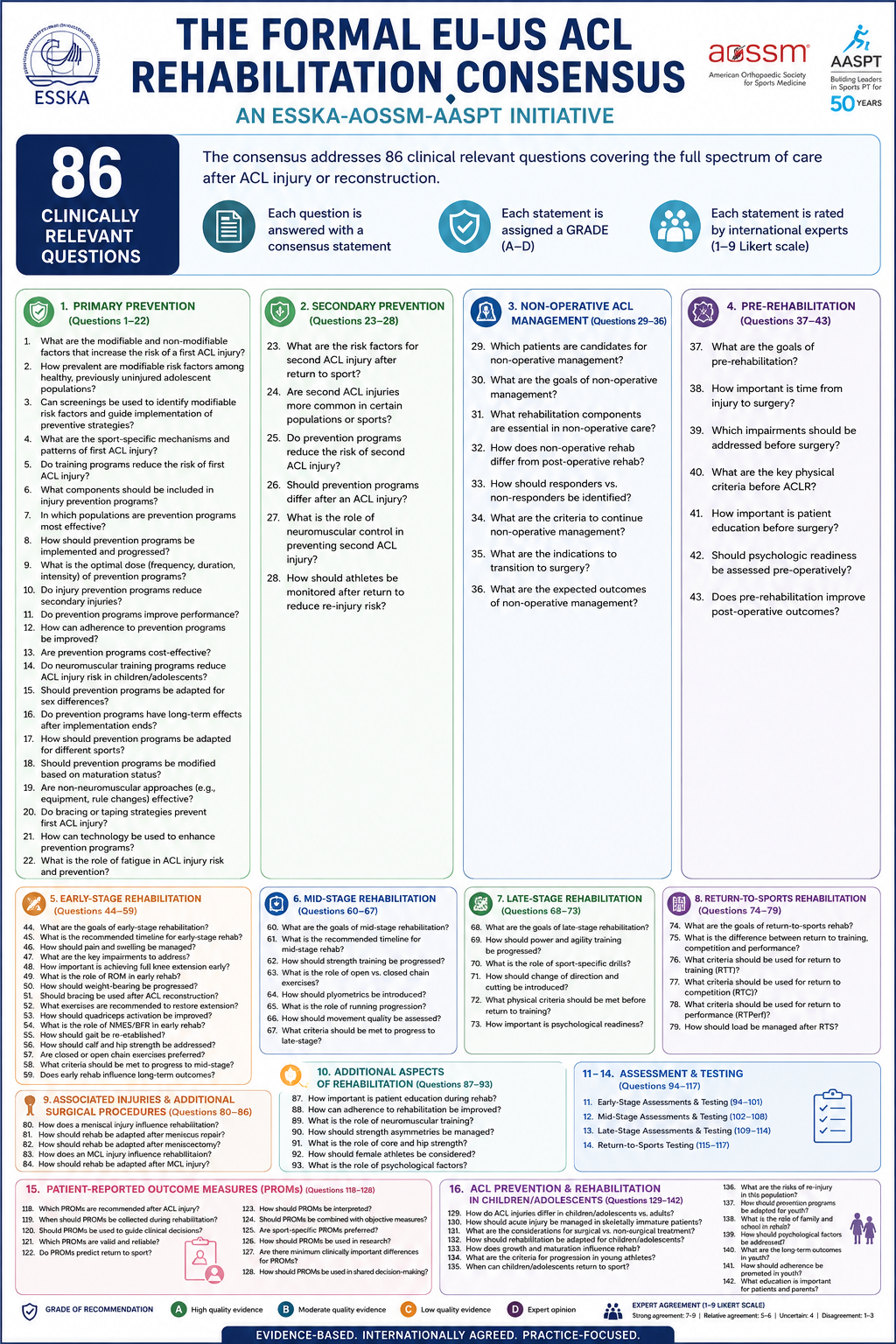
The ESSKA–AOSSM–AASPT Formal EU-US ACL Rehabilitation Consensus is built around 86 clinically relevant questions covering the entire ACL pathway—from injury prevention and non-operative management to rehabilitation after ACL reconstruction, return to training, return to competition, and return to performance.
Each question is answered through a structured consensus statement, accompanied by a grade of recommendation (A–D) reflecting the strength of the available evidence and a formal expert agreement rating (rating group).
The complete report contains all 86 questions, but they span 178 pages. From the table of contents, the questions are organized into the following domains:
- Prevention of ACL Injuries – Primary Prevention: Q1–Q22
- Prevention of ACL Injuries – Secondary Prevention: Q23–Q28
- Non-Operative ACL Management: Q29–Q36
- Pre-Rehabilitation Prior to ACL Reconstruction: Q37–Q43
- Early-Stage Rehabilitation: Q44–Q59
- Mid-Stage Rehabilitation: Q60–Q67
- Late-Stage Rehabilitation: Q68–Q73
- Return-to-Sport Rehabilitation: Q74–Q79
- Associated Injuries & Additional Surgical Procedures: Q80–Q86
Complete Question List
- What are the modifiable (e.g., biomechanical/neuromuscular)/non-modifiable factors that increase the risk of the first ACL injury?
- How prevalent are modifiable risk factors among healthy, previously uninjured adolescent populations?
- Can screenings be used to identify modifiable risk factors and guide implementation of preventive strategies?
- What are the sports-specific mechanisms and patterns of first ACL injury?
- What components are included in programs that have been shown to reduce ACL injury risk?
- What established programs are there for ACL prevention?
- Are there sport specific programs aiming to reduce ACL injury risk?
- What is the best frequency, time and duration (dose) in these training programs to reduce the risk of ACL?
- Who should provide training to athletes for primary ACL risk reduction, when and where?
- What modifiable/non-modifiable factors increase the risk of an ipsilateral or contralateral second ACL injury?
- Does early management (diagnosis, education and treatment) of primary ACL injury reduce the risk of further intra-articular knee injury?
- Which providers, in which settings, and at what time points should deliver neuromuscular training to athletes to reduce the risk of a second ACL injury?
- What factors are unique to second ACL injury prevention (risk reduction)?
- Who is a candidate for non-operative ACL rehabilitation (what factors guide (shared) decision- making when considering non-operative management?
- What specific treatment strategies (components/processes) are recommended for those undergoing non-operative ACL management?
- What education is needed for those with ACL injury who are deciding not to undergo surgery (including activity modification, reasons for re-evaluation/consultation)?
- What are the rehabilitation milestones and criteria for RTS for someone who does not undergo ACL surgery?
- How might pre-operative rehabilitation be useful to maximize outcomes of ACL reconstruction?
- What are the main goals of pre-operative rehabilitation (e.g. impairment resolution) to maximize outcome?
- What rehabilitation interventions are recommended prior to ACL surgery?
- Do the goals of pre-op rehabilitation differ depending on the intended graft type?
- Which specific pre-operative measures (functional or self-reported) are useful to inform post-operative rehab?
- What are the key components of patient education to prepare individuals for post-surgical recovery after ACL reconstruction?
- When should rehabilitation commence following ACL surgery?
- What is the main focus/goals of early-stage rehabilitation following ACL surgery?
- Which interventions must be recommended to reach the goals of the early phase of rehabilitation?
- Is a post-operative knee brace suggested after isolated ACL reconstruction?
- Which criteria (time/performance) should be used to allow the patient to walk without crutches?
- What are the post-operative factors amenable to rehabilitation that are associated with loss of motion (cyclops lesion, arthrofibrosis)?
- What are the goals (and optimal timeframe) for restoring ROM of the knee after ACL reconstruction?
- How does early post-operative rehabilitation need to be adjusted (frequency, duration, interventions) if goals for restoring ROM have not been achieved?
- How might hydrotherapy be a useful adjunct to gym-based rehabilitation following ACL surgery?
- What are the benefits (or harms, if any) to the use of blood flow restriction training during the early stage of post-operative rehabilitation after ACL reconstruction?
- What are the benefits (or harms, if any, e.g. due to harvest site) for routine use of neuromuscular electrical stimulation (NMES) to improve quadriceps muscle performance in the early post-operative period after ACL reconstruction?
- How should early rehabilitation be modified according to the autograft used for ACLR?
- When should open kinetic chain knee extension/flexion strengthening be implemented post ACLR?
- What criteria should be met before moving to mid stage rehabilitation?
- What is the main focus/goals of mid stage rehabilitation following ACL surgery?
- How should mid stage rehabilitation be modified accordingly to the graft used for ACLR?
- What strategies should be used to support the restoration of knee extensor strength?
- What criteria should be used to guide progression through rehabilitation?
- Which criteria should be used to clear the patient to return to running in a straight line?
- What criteria should be met before moving to late-stage rehabilitation?
- What is the main focus/goals of late-stage rehabilitation following ACL surgery?
- What strategies should be used in late-stage rehabilitation?
- Which criteria should be met to start specific on-field rehabilitation?
- What criteria should be used to determine readiness for multi-directional maneuvers?
- What are criteria for return to regular training?
- How should rehabilitation be modified according to specific sports?
- Which domains (psychological, functional etc) should be considered in the return to sport decision?
- What are criteria for returning to competition?
- Who should be involved in delivering late-stage rehabilitation and where should it be carried out?
- What sport-specific return to sport process (on field rehab, team training, match play) should be followed after completion of the late-stage rehabilitation process?
- What should be the components (e.g. speed, reactive, technical) of return to sport training?
- What sport-specific return to sport programs are available?
- How does return to sport training impact outcomes post ACL injury/reconstruction?
- Which common associated injuries require modification of ACL rehabilitation milestones and timeline of ACL rehabilitation protocols?
- How do non-operatively treated MCL injuries influence ACL rehabilitation?
- How do the following associated surgeries influence ACL rehabilitation?
- How does the presence of associated injuries influence patient education and advice with respect to RTP and long-term knee health?
- How does the addition of an osteotomy influence rehabilitation?
- How is compliance (adherence) in a structured criteria-based rehabilitation pathway associated with outcomes after ACL injury/reconstruction?
- When and how should kinesiophobia and fear of reinjury be addressed?
- How should complications during the rehabilitation process be addressed and what might be considerations for referral back to the referring physician?
- What are recommended differences in rehabilitation management after ACL revision surgery compared to after primary ACL reconstruction?
- Are there sex-specific issues to consider in rehabilitation after ACL injury/reconstruction?
- How should arthrogenic inhibition be identified and addressed during different stages of rehabilitation?
- What is the role of neurocognitive training and brain adaptations after ACL injury?
- What unique rehabilitation is recommended for ACL repair?
- What methods should be used (and results interpreted) to identify whether the criteria for progression to mid-stage have been reached?
- What methods should be used to identify whether the criteria for progression to late stage have been reached?
- What methods should be used (and results interpreted) to identify whether the criteria for progression to RTS training have been reached?
- What are the main sport-specific tests for decision-making in RTS?
- Which ACL- or knee-specific PROMs should be used to assess rehabilitation progress and for what purpose (physical, psychological status)?
- What is the usefulness of generic/general PROMs (such as PROMIS) for assessing progress and outcomes after ACL reconstruction?
- How can PROMs be used to determine progression through the post-operative rehabilitation program (transition from one phase of post-operative rehabilitation to the next)?
- Are PROMs useful for guiding/informing return to sports and return to performance decisions after ACL reconstruction?
- Can PROMs be used to create risk adjusted (e.g. by age/gender) PRO-based measures to judge quality and value of rehabilitation after ACL injury?
- How does pubertal status (physical aspects and emotional maturity) affect prevention program design and implementation?
- What validated prevention programs exist to reduce injury risk (Age specific?
- What are the short and long-term impacts of ACL injury risk reduction programs on children’s health?
- What specific types of risk reduction interventions are necessary to include in exercise-based ACL injury risk reduction programs for children?
- What is the optimal timing and (i.e. pre-season, in-season, hybrid, etc) and optimal dosage (e.g., frequency, duration) of an ACL injury prevention program for children?
- How does rehabilitation differ (content and focus) in pediatric patients and why?
- What is critical information for the pediatric patient and caretakers?
- How is ACL injury rehabilitation best implemented in pediatric patients (at home, in school, in sport clubs)?