My article of the month (September 2024)
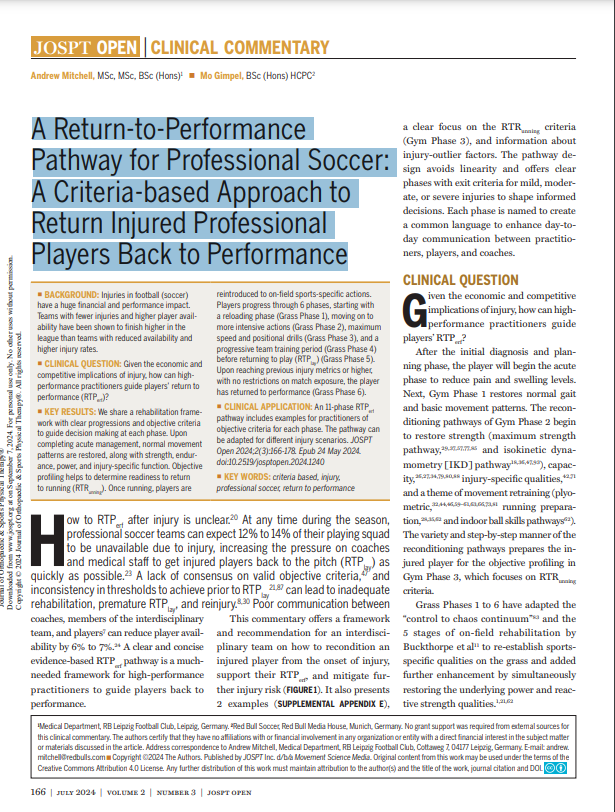
My article of the month (September 2024) comes from Andrew Mitchell and Mo Gimpe, titled “A Return-to-Performance Pathway for Professional Soccer: A Criteria-based Approach to Return Injured Professional Players Back to Performance.
Planning for a successful return to play after an anterior cruciate ligament (ACL) injury can be a challenging journey for professional soccer players. An ACL injury can not only disrupt a player’s career but also pose risks of reinjury if not managed properly. Achieving successful rehabilitation after an ACL injury requires a clear end goal and a well-defined plan.
One of the reasons I chose this article is that it is written with clear clinical experience in mind.All ACL rehab programs should be built on a set of criteria. Unfortunately, this is still far from the case in many places. Having your criteria in place will make it much easier to deliver a structured pathway for ACL rehabilitation. Always ask your physiotherapist what criteria you are chasing.
This is why I’m a big fan of this Clinical Commentary, as it offers an 11-phase pathway, each with specific criteria that must be met before progressing to the next phase. It is designed to ensure a safe and effective return to play by focusing on objective measurements and tailored rehabilitation programs.

Here is a summary of the 11 phases:
- Diagnosis and Planning Phase: This initial phase involves assessing the player’s physical and emotional distress, providing a diagnosis, and planning management options based on factors such as age, injury severity, and psychosocial situation.
- Acute Phase – Acute Management and Modified Conditioning: Focuses on acute injury management, including pain and swelling reduction, and modified conditioning for the rest of the body.
- Gym Phase 1 – Early Loading and Normal Movement: Restoring basic movement pattens with early loading and restoration of normal movement patterns, pain-free walking, and exercises such as squats, lunges.
- Gym Phase 2 – Reconditioning Pathways: Reconditioning pathways to enhance strength, capacity, injury-specific qualities, and movement retraining, including plyometrics and running preparation.
- Gym Phase 3 – Return to Running: Objective profiling to determine readiness for returning to running (RTRunning), with a focus on power criteria.
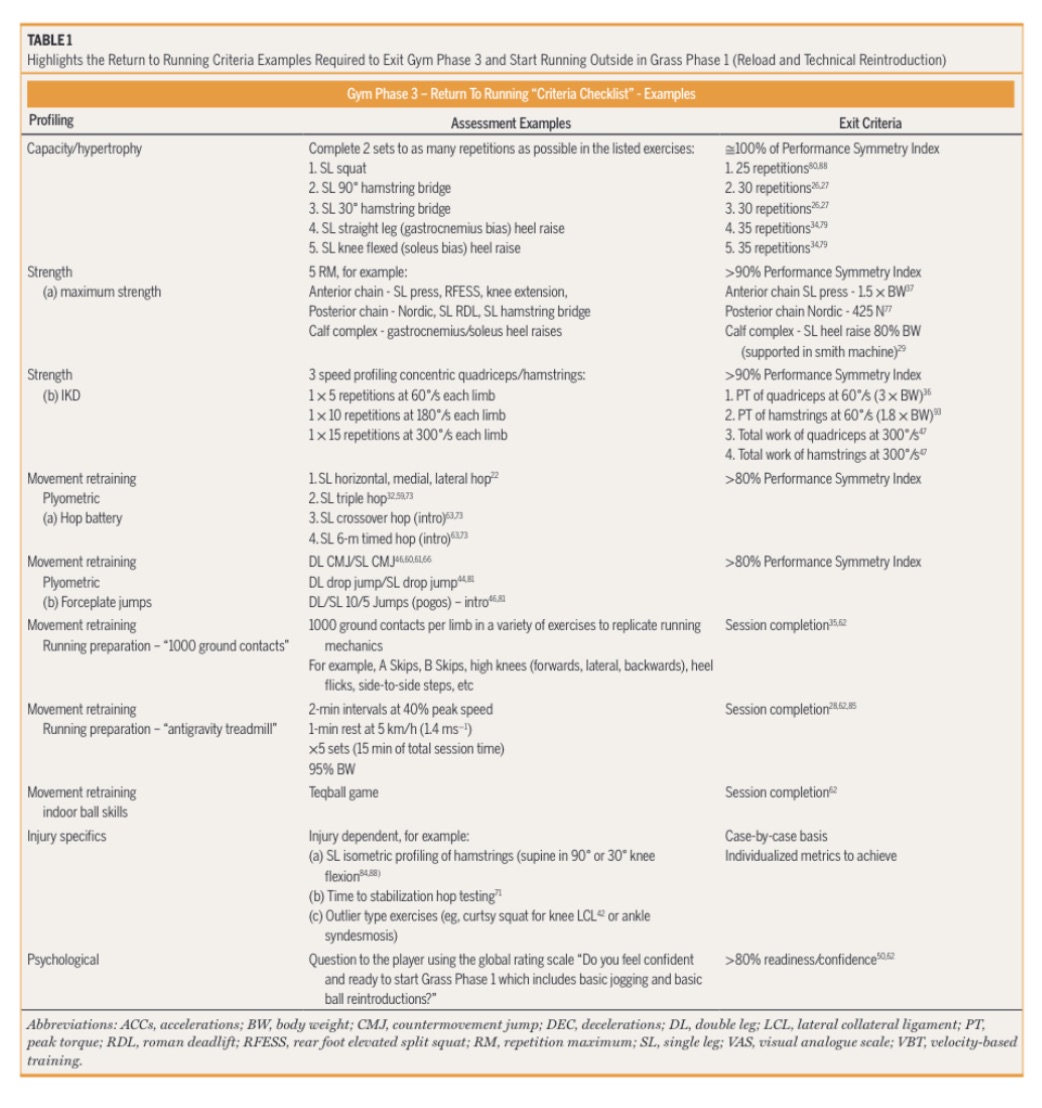 6. Grass Phase 1 – Reloading and Technical Reintroduction: Reloading and technical reintroduction to the grass, increasing aerobic fitness and restoring power criteria for high-speed running.
7. Grass Phase 2 – HSR and Agility Drills: High-speed running and agility drills, restoring reactive strength qualities for maximum speed and positional drills.
8. Grass Phase 3 – Maximum Speed and Positional Drills: Maximum speed and positional drills, focusing on sports-specific movements and enhancing underlying power and reactive strength qualities.
9. Grass Phase 4 – Return to Training: Gradual exposure to team training, including team warm-ups, passing drills, and phases of play, progressing from neutral to full contact.
10. Grass Phase 5 – Return to Playing: Gradual exposure to competitive match play, monitored based on gym-based injury-specific criteria.
11. Grass Phase 6 – Return to Performance: Return to performance, where the player has reached previous injury metrics or higher, with no restrictions on match exposure, indicating a full return to competitive play.

Conclusion
The criteria-based approach presented by Mitchell and Gimpel offers a valuable framework for ACL rehabilitation in professional soccer players. By focusing on objective measurements, tailored rehabilitation programs, and effective communication, this approach aims to minimize the risk of reinjury and facilitate a successful return to competitive play.